Best Shed Base Options For Uneven Ground
Imagine you are setting up a shed or a cabin on uneven ground and you find out it’s unstable. Well, this is the most common issue people are facing when they are constructing a new shed. The base beneath any shed plays a vital role in its safety, durability and functionality. As an experienced shed builder in Michigan, I will guide you how to choose the right foundation for an uneven ground so you can avoid costly mistakes.
What are Uneven Terrains / Ground?
Uneven Terrain refers to the ground that is not level or uniform in shape and composition. It could contain slopes, rocky ground, forest floors with root and active construction zones where the soil may be compacted unevenly. These surfaces present several challenges during building or installation. Structures placed on such terrain often face instability, poor drainage, and difficulty in securing anchors. Shifting soil or water runoff can also lead to long-term damage or movement of the foundation. Understanding the nature of uneven terrain is the first step in selecting a base design that can handle these specific demands.
Why Does a Strong and Stable Shed Foundation Matters?
A stable base design is essential for maintaining the structural integrity of any shed, no matter the size. A strong foundation evenly distributes weight, supports the structure against shifting ground, and it also keeps everything on level over time. From a safety perspective, a stable base reduces the risk of accidents, tipping, or collapse, which can occur when foundations fail on uneven terrain. Investing in the right base design from the beginning also leads to greater durability. It minimizes the need for repairs or reinforcement that saves both time and money in the long run. A well-built foundation is the key behind the sheds that have been standing from decades.
Criteria for Evaluating a Base Design on Uneven Terrain
Choosing the right base design for uneven terrain involves more than selecting something that fits. It requires evaluating several key criteria so the foundation will perform well under the specific conditions of the site and the demands of the structure.
- Load-bearing capacity is the first and most important factor. The base must support the full weight of the structure, including dynamic forces like wind or movement, without shifting or settling over time.
- Adaptability to terrain shape means the design should conform to the natural slope or irregularities of the ground. Some systems, like adjustable footings or helical piles, are specifically built for this purpose.
- Ease of installation is crucial, especially for remote or DIY projects. A base that can be installed with basic tools or minimal excavation can reduce labor costs and project timelines.
- Resistance to erosion and weather keep the base stable over time. This includes protection against water runoff, frost heave, and soil displacement, all of which are common in uneven terrain environments.
- Compatibility with the structure must be a priority. A base design suitable for a lightweight tent will not be appropriate for a small cabin or heavy machinery. Matching the foundation type to the structure’s requirements is essential for safety.
- Sustainability and environmental impact are highly important. Some base systems minimize ground disturbance, use recycled materials, or avoid the need for concrete, making them better choices for environmentally sensitive areas.
Checking the base design against these criteria will help in long-term performance, safety, and environmental responsibility.
7 Best Shed Base Options For Uneven Ground
If your ground isn’t level, choosing the right shed base is really important. Some foundations work better than others on slopes, soft soil, or rocky areas. Below are the best shed base options that can help you build safely and avoid future problems, even if your ground is uneven.
1- Concrete Piers / Deck Blocks
Concrete piers or precast deck blocks are individual footings placed at key points under the shed floor joists. They can be set into the ground or rest on leveled gravel pads. Each pier can be placed at different depths to accommodate sloped or rocky ground. Height can be adjusted with pier/post brackets.
Concrete Piers are extremely stable, suitable for heavy sheds and it allows the airflow underneath which prevents mold growth. It requires digging and precise leveling, also it is not suitable for highly shifting soils.


2- Gravel Pad with Timber Frame (Boxed Gravel Base)
This base uses pressure-treated timber to form a perimeter “box,” filled with compacted gravel to create a level foundation. The box frame is partially buried and leveled, then gravel is added and compacted to form a stable, drainable base even on moderate slopes.
It provides excellent drainage, easy to build, low cost, eco-friendly and resists forest heaves. But, it requires periodic leveling and it is not considered a best choice for steep slopes.
3- Plastic Shed Bases with Grid Systems
This base uses pressure-treated timber to form a perimeter “box,” filled with compacted gravel to create a level foundation.The box frame is partially buried and leveled, then gravel is added and compacted to form a stable, drainable base even on moderate slopes.
It provides excellent drainage, easy to build, low cost, eco-friendly and resists forest heaves. But, it requires periodic leveling and it is not considered a best choice for steep slopes.

4- Adjustable Foundation Posts/ Screw Piles
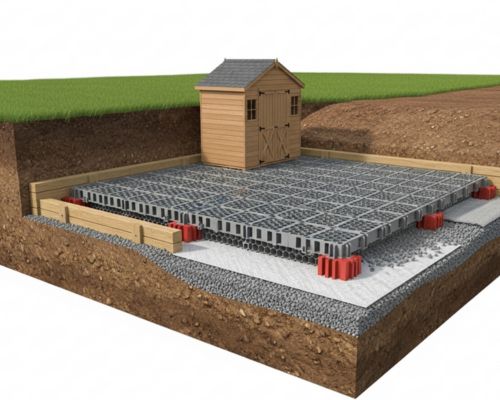
Plastic shed bases with interlocking grid systems are lightweight, modular, and often made from recycled materials. These bases can be placed over slightly uneven ground with gravel or sand used underneath for leveling and drainage.
They are quick to install, environmentally friendly, and provide good airflow and moisture protection beneath the shed. Their modular nature also makes them ideal for smaller sheds and tight spaces. However, they are not designed for steep slopes or heavy structures, and may require a level sub-base to function effectively.
5- Timber Skid Foundation
A timber skid foundation uses large, pressure-treated beams that are laid directly on the ground or over gravel pads to support the shed. It’s one of the simplest and most cost-effective options, particularly useful for small to medium-sized sheds on slightly uneven ground.
This type of base is quick to install, flexible, and even portable that makes it ideal for temporary or movable structures. However, it may be prone to moisture damage if there is no proper drainage underneath, and is less suitable for steep slopes or heavy sheds that require more rigid support.


6- Concrete Slab with Grading Work
A concrete slab foundation is made by pouring a flat, reinforced slab after leveling and grading the ground which makes it extremely stable. This type of base is best suited for flat or properly graded uneven terrain.
It is ideal for heavy sheds, workshops, or garages that require a solid floor. However, it’s the most expensive and labor-intensive option and often requires permits and site preparation.
7- Post and Beam Foundation
The post and beam foundation uses vertical posts anchored in concrete or buried directly into the ground to support horizontal beams that support the shed floor. Each post can be cut to a custom height, making this system especially effective on sloped or uneven land.
It provides strong, stable support and allows for airflow underneath the shed that reduce the moisture issues. While it’s one of the most adaptable and long-lasting designs, it does require advanced planning, precise measurements, and more labor than simpler base types, which may deter beginners.

How to Choose the Right Base for Your Terrain
Selecting the right shed base design depends on multiple factors, including the slope of your land, soil type, your budget, and whether you’re tackling the project as a DIYer or hiring a professional. The goal is to match the base type to the needs of your shed and the challenges of your terrain.
| Base Type | Best For | Ideal For |
|---|---|---|
| Concrete Piers / Deck Blocks | Moderate to steep slope | Heavy sheds, rocky terrain |
| Gravel Pad with Timber Frame | Slight to moderate slope | Small sheds, drainage-prone soil |
| Plastic Grid Base | Nearly flat | Lightweight sheds, quick installs |
| Screw Piles / Adjustable Posts | Highly uneven or soft ground | Unstable soil, steep gradients |
| Timber Skid Foundation | Mild slope | Budget builds, movable or temporary sheds |
| Concrete Slab | Graded or leveled areas | Permanent, high-traffic sheds or workshops |
| Post and Beam Foundation | Steep or irregular slope | Long-term, professional or elevated structures |
Expert Tip: When to Call a Professional
If your terrain has a steep grade (10%+), unstable soil (like clay or sand that shifts), or you’re planning a heavy-duty shed with utilities, it’s wise to consult a licensed contractor or structural engineer. They can assess ground conditions, advise on proper anchoring, and make sure your base meets local building codes. Poor foundation planning is one of the top causes of shed failure and hiring a pro upfront can save thousands in repair costs later.
Common Mistakes to Avoid
- Ignoring drainage considerations: Failing to account for proper water runoff around the shed base can lead to standing water beneath the shed which in turn accelerates rot, mold, and structural damage. Always factor in slope, gravel layering, and surrounding drainage channels to prevent water accumulation.
- Failing to level the base accurately before installation: Overtime an uneven base causes the shed frame to twist over time that leads to misaligned doors, cracks, and even structural collapse. Always use a laser or spirit level and double-check at multiple points before proceeding.
- Choosing the wrong foundation materials for your specific soil type: Using heavy concrete bases on loose or sandy soil, or lightweight plastic grids on shifting clay can result in sinking or movement. Always test your soil and match it with the foundation designed for those conditions.
- Skipping required permits or ignoring local building codes: Not checking with your local building authority can result in fines, forced removal, or inability to sell your home later. Always verify permit requirements, zoning setbacks, and code compliance before starting work.
Real-World Case Studies of Our Shed Building On Uneven Ground
We know choosing the right shed base can feel tricky, especially on an uneven ground. These real-world experiences show how Effortless Shed helped different homeowners tackled sloped or rocky terrain using smart foundation choices. Learn from their challenges to better plan your own shed project and avoid common mistakes during construction.
Case Study 1: Concrete Piers on a Rocky Slope in Michigan’s Keweenaw Peninsula
A steep backyard with compacted clay and exposed rock patches in Keweenaw Peninsula, sloping at around 12%.
- Shed Type and Base Used:
A 12×16 heavy-duty wood workshop with a concrete pier foundation. - Challenges and Solutions:
The rocky terrain made digging for pier footings extremely difficult. The homeowner rented a hammer drill to penetrate rocky areas and used a laser level to ensure uniform pier height across the slope. - Outcome: The shed has stayed perfectly level over three winters, with no signs of heaving or movement. The open underside allows great airflow, and runoff drains well around the piers. It became a featured DIY post in a regional homesteading forum.
Case Study 2: Gravel Pad with Timber Frame on a Slight Slope in Antrim County, Northern Michigan
Gently sloping suburban backyard (about 6% grade) with well-draining loamy soil.
- Shed Type and Base Used: An 8×10 garden shed built on a timber-framed gravel pad (boxed gravel base).
- Challenges and Solutions: The slight slope required digging down the higher side and building up the lower side of the timber box to achieve level footing. Multiple gravel layers were compacted with a plate compactor to prevent settling.
- Outcome: After two years of seasonal rain and mild frost, the base remains stable with no sagging or erosion. The shed is dry inside, and the homeowner reports that weeds around the base have been minimal thanks to landscaping fabric.